
The digital ecosystem is undergoing a monumental shift driven by evolving consumer expectations, stricter global regulations, and technical changes across major browsers and operating systems. Today, Privacy in Digital Marketing is no longer just a legal compliance requirement or an isolated technical policy; it is a core business imperative that directly influences customer trust, brand equity, and campaign profitability. For decades, online advertising relied heavily on third-party cookies, cross-site tracking pixels, and invasive data collection methods to build detailed user profiles and execute hyper-targeted promotional campaigns. However, as public awareness surrounding data protection grows, prioritizing Privacy in Digital Marketing has become essential for brands seeking long-term sustainability.
Understanding the Need for Privacy in Digital Marketing
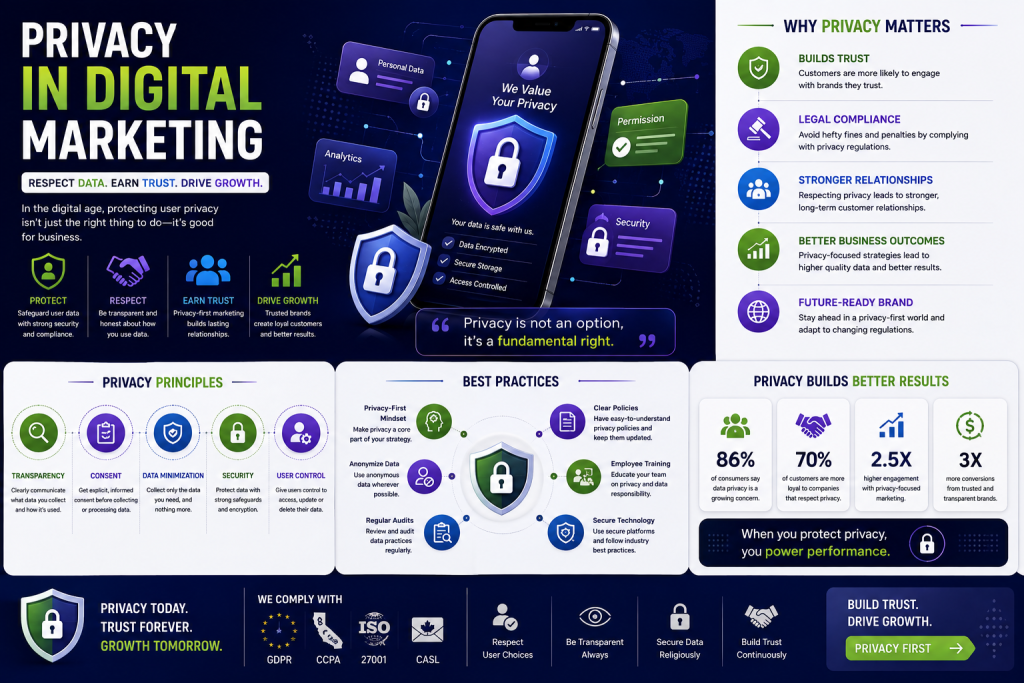
The momentum behind stems from three primary catalysts: legislative regulations, technical restrictions, and changing user attitudes. Regulatory frameworks like the European Union’s General Data Protection Regulation (GDPR) and the California Consumer Privacy Act (CCPA) established strict parameters around how consumer information can be collected, stored, and utilized. These legal directives forced brands to rethink their data collection mechanisms and highlight Privacy in Digital Marketing across all customer touchpoints.
At the same time, tech companies have accelerated the transition by enforcing technical restrictions. Web browsers like Apple’s Safari and Mozilla’s Firefox blocked third-party cookies years ago, while Apple’s App Tracking Transparency (ATT) framework empowered mobile users to opt out of cross-app tracking with a single tap. Google has similarly introduced privacy-focused initiatives for Chrome and Android to limit individual identification while providing aggregated performance signals. These industry-wide shifts mean that upholding Privacy in Digital Marketing is mandatory for any brand trying to navigate modern digital channels.
The Impact of Privacy in Digital Marketing on Traditional Measurement
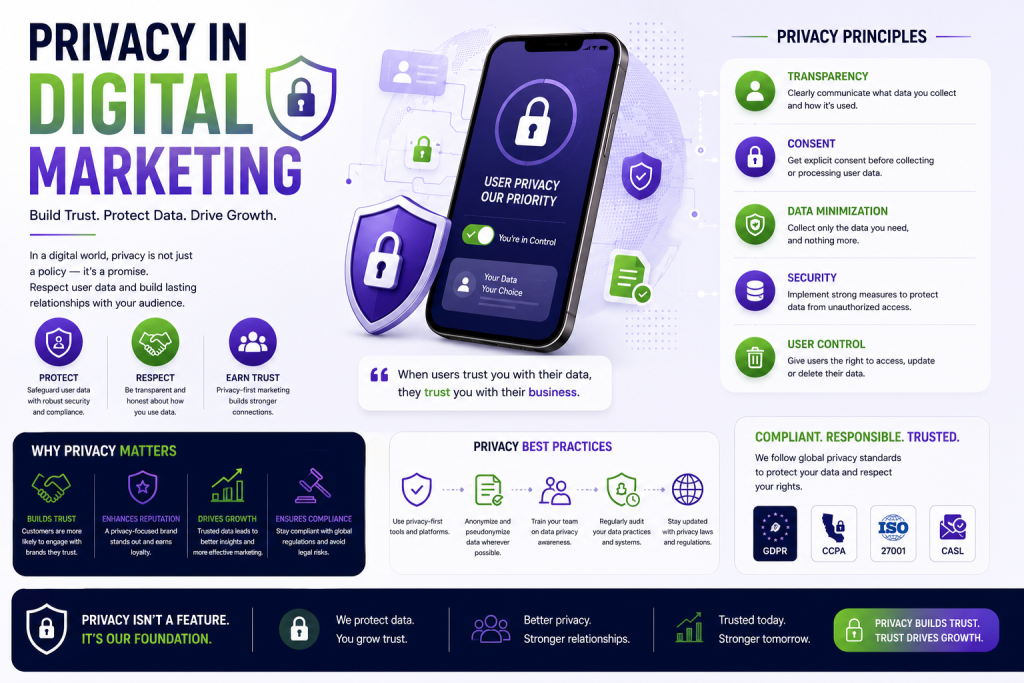
The decline of third-party identifier tracking has significantly altered how digital marketers measure, attribute, and optimize campaign performance. Historically, multi-touch attribution models allowed media buyers to track a user’s exact digital journey across multiple websites before they completed a purchase. Today, prioritizing Privacy in Digital Marketing limits multi-site tracking, making direct attribution far more complex.
Without deterministic tracking data, measuring return on ad spend (ROAS) requires new, consent-compliant methodologies. Digital marketers can no longer rely on granular individual tracking to validate performance. By adapting measurement techniques to respect Privacy in Digital Marketing, brands can evaluate media effectiveness accurately without compromising user anonymity or violating data safety guidelines.
Key Pillars for Implementing Privacy in Digital Marketing
To build a resilient strategy centered on Digital Marketing, organizations must restructure their data gathering and campaign execution around several core operational pillars.
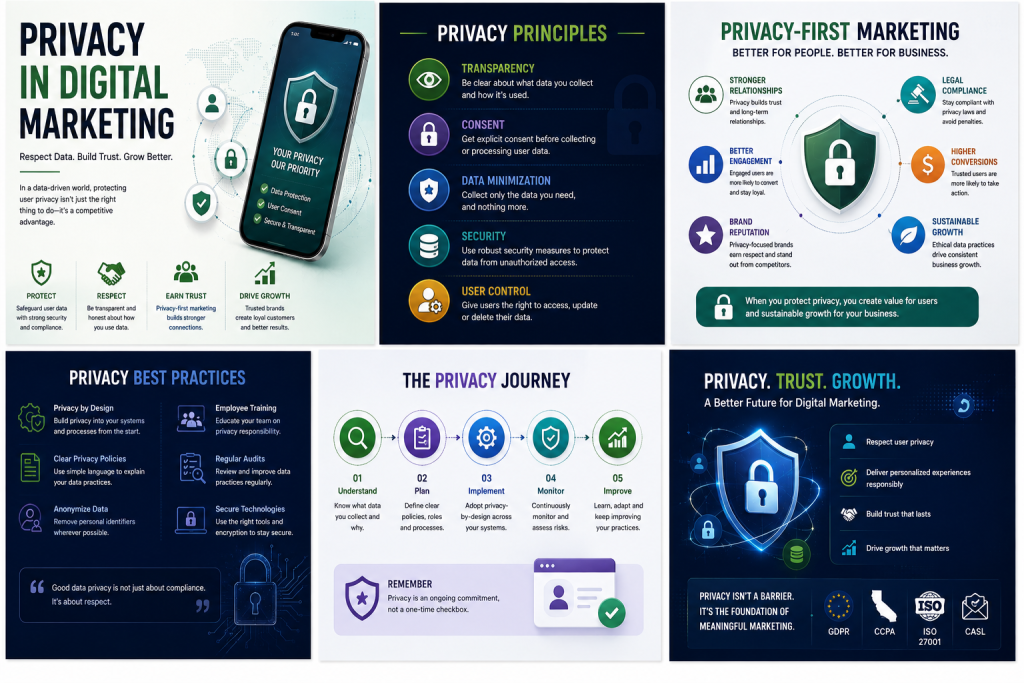
1. First-Party Data Collection and Privacy in Digital Marketing
As external tracking mechanisms disappear, building a robust first-party data asset becomes the foundation of success. First-party data refers to information gathered directly from your audience with explicit consent through interactions on your website, email sign-ups, customer loyalty programs, or direct sales. Emphasizing Privacy in Digital Marketing ensures that when consumers share their contact details, preferences, or purchasing history, they do so willingly because they perceive clear value in return. Transparent consent banners, clear value exchanges, and robust data management practices protect user trust while feeding personalized marketing initiatives.
2. Zero-Party Data and Explicit Privacy in Digital Marketing
Taking data transparency a step further, zero-party data includes information that a customer intentionally and proactively shares with a brand. This can include survey responses, product preference quizzes, communication frequency choices, or wishlist items. Integrating zero-party data into your strategy honors Digital Marketing by eliminating invasive behavioral inference. Instead of guessing user interest based on background web activity, marketers simply ask users what they prefer, creating a mutually beneficial relationship grounded in transparency.
3. Server-Side Tracking for Enhanced Privacy in Digital Marketing
Traditional client-side tracking relies on scripts executing directly within a user’s web browser, exposing user IP addresses and browsing behaviors to third-party ad networks. Switching to server-side tracking strengthens Digital Marketing by routing data from the web server directly to a controlled cloud environment. This setup allows businesses to sanitize, filter, and anonymize user information before transmitting required signals to advertising platforms, ensuring that user data remains protected and compliant with privacy laws.
4. Contextual Targeting and Respecting Privacy in Digital Marketing
Prior to the rise of behavioral tracking, advertising relied on placing ads within relevant content environments. Modern contextual targeting has emerged as a powerful, privacy-compliant alternative to hyper-focused behavioral profiling. By placing advertisements on web pages directly related to the product or topic being consumed—rather than tracking the specific person reading the page—brands align with Digital Marketing. Contextual placement respects user boundaries while maintaining high relevance and engagement.
Overcoming Challenges While Maintaining Privacy in Digital Marketing
Transitioning away from invasive tracking presents operational hurdles, but treating Privacy in Digital Marketing as a competitive advantage allows forward-thinking brands to differentiate themselves in crowded markets.
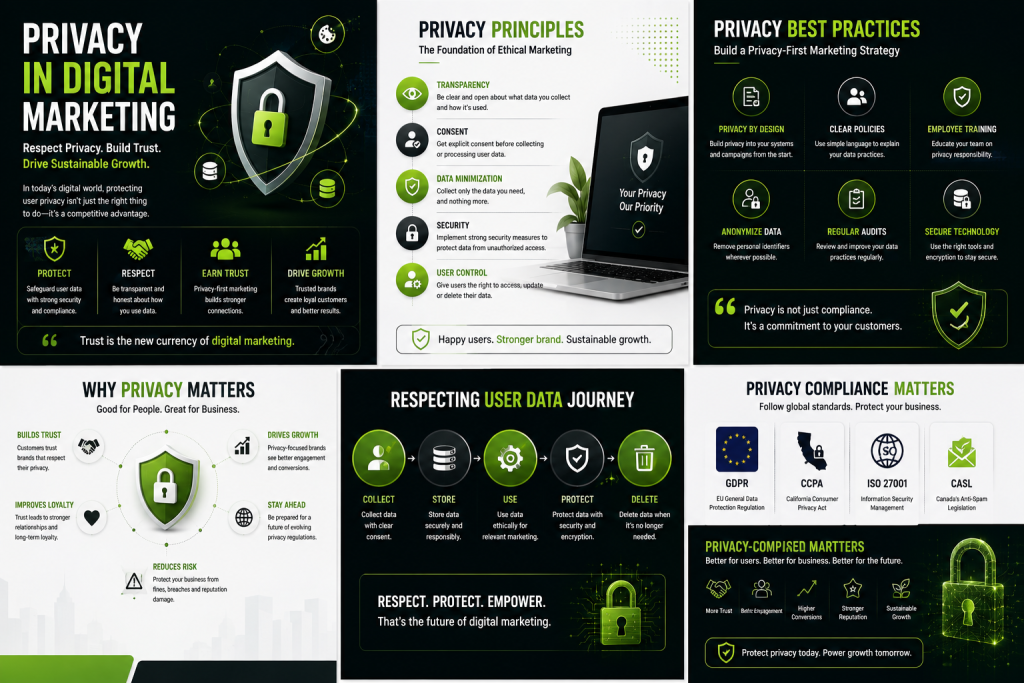
- Rebuilding Audience Segments: Audience retargeting based on third-party cookie lists is no longer reliable. Marketers must construct custom audience pools using privacy-compliant customer data platforms (CDPs) and clean rooms that aggregate data securely.
- Managing Consent Frameworks: Implementing clear, user-friendly cookie consent banners and preference centers demonstrates a commitment to Digital Marketing. Consent mechanisms should be intuitive rather than deceptive, allowing users to control their data sharing easily.
- Adopting Artificial Intelligence and Predictive Modeling: Privacy-compliant advertising platforms increasingly rely on machine learning algorithms to fill data gaps created by tracking opt-outs. Leveraging AI-driven predictive modeling enables brands to optimize bids and forecast audience behavior while honoring Privacy in Digital Marketing.
The Future of Growth and Privacy in Digital Marketing
The evolution of digital channels makes one truth clear: invasive, opaque tracking methods belong to the past. The future of online growth relies on building transparent, trust-based relationships with consumers. Prioritizing Digital Marketing does not mean sacrificing marketing effectiveness; rather, it forces organizations to focus on delivering authentic value, clear messaging, and exceptional user experiences.
By investing in first-party data infrastructure, adopting server-side measurement tools, utilizing contextual targeting, and maintaining complete transparency, businesses can navigate ongoing industry shifts confidently. Embracing Digital Marketing allows brands to foster long-term customer loyalty, safeguard their corporate reputation, and achieve sustainable revenue growth in a privacy-first world.